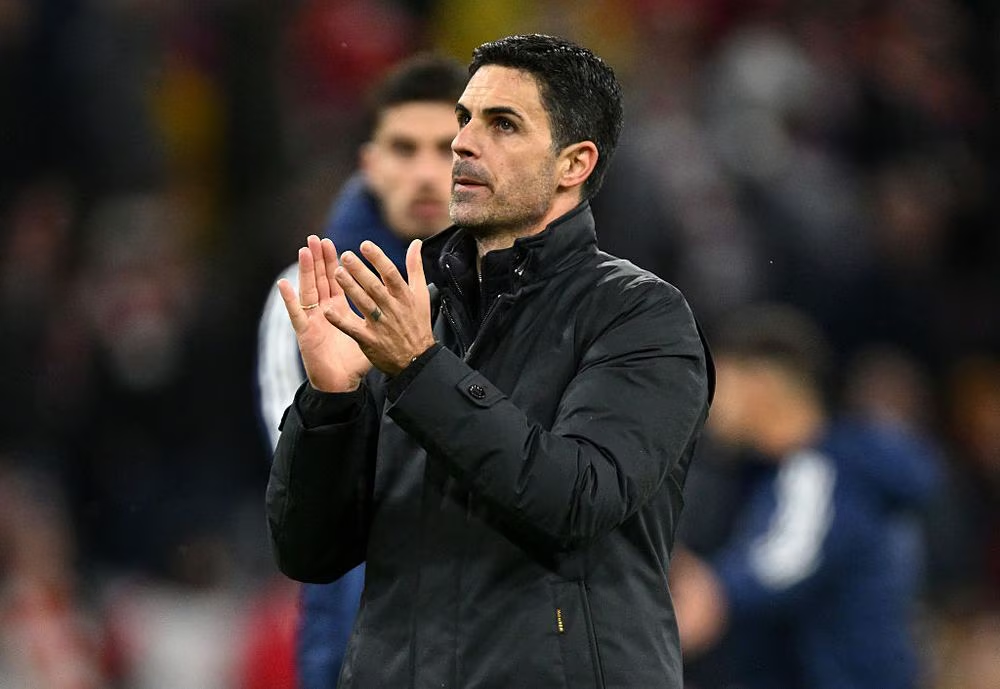
Leaving the Allianz Arena with a 2–2 draw against FC Bayern Munich is a major statement of intent for Arsenal F.C. Yet, while the result highlights how far Mikel Arteta’s project has progressed on the continental stage, the ninety minutes also exposed critical realities that the Gunners must navigate if they are to lift the UEFA Champions League trophy.
By expanding on the structural changes, tactical triumphs, and rotational friction seen in Munich, this full analysis breaks down the 7 key takeaways focusing entirely on Arsenal’s performance, tactical identity, and squad dynamics.
1. The Death of the Allianz Arena Phobia: A New Elite Mentality
In previous eras, conceding a quick-fire second-half comeback in an intimidating stadium like the Allianz Arena would have caused an Arsenal collapse. The ghosts of past 5-1 defeats used to linger heavily. Instead, Arteta’s side showed incredible emotional maturity.
When a controversial penalty put them 2–1 down in a hostile atmosphere, the team refused to panic or abandon their tactical principles. They stuck rigidly to their defensive blocks, gradually wrested back control of the midfield, and maintained the technical composure needed to execute a precise, late equalising sequence. This resilience proves that Arsenal now possess the psychological steel required of genuine European heavyweights.
2. A Bench Engineered for Spring: “Champions League Quality” Depth
For years, a catastrophic injury to a talismanic player like Bukayo Saka would have derailed Arsenal’s entire season. Losing him just 10 minutes into a flagship European night was a worst-case scenario. However, the subsequent response demonstrated the immense growth of this squad.
Eberechi Eze stepped directly into the spotlight, adjusting seamlessly to the tempo to score the opening goal. Later in the half, when the game began to stall, it was Viktor Gyökeres coming off the bench to bully the Bayern backline and assist the equalizer. Arteta finally has a match-day squad where substitutions do not represent a drop in quality, but rather a shift in tactical weaponry.
3. The Center-Forward Dilemma: Havertz vs. Gyökeres
The match perfectly illustrated the ongoing tactical evolution occurring leading Arsenal’s front line. Kai Havertz is a master of spatial manipulation, dropping deep into half-spaces to combine with Martin Ødegaard and disrupt low blocks. However, when Bayern’s defense squeezed the central corridors in the second half, Arsenal lacked a traditional “box threat” capable of physically pinning back Dayot Upamecano and Kim Min-jae.
Gyökeres’ immediate physical impact off the bench transformed the dynamic. His ability to act as a direct, aggressive focal point ran the channels and dragged defenders out of position, posing a vital question for Arteta: against Europe’s elite, is fluid interchanging always preferable to raw physical presence?
4. Navigating the Right-Wing Void and Creative Over-Reliance
With Saka forced off early, Arsenal’s attacking mechanics were fundamentally altered. While Eze performed admirably on the night, the tactical system naturally missed Saka’s specific profile—his unique ability to demand double-teams on the right flank, which inherently opens up operating space for Ødegaard.
Without that predictable wide gravity drawing Bayern’s full-backs away, Arsenal’s attacking sequences through central channels became slightly predictable during the middle third of the game. It highlighted an ongoing vulnerability: when the primary wide outlet is removed, the central creative engine has to work twice as hard to manipulate space.
5. Control-First Football Minimises European Chaos
Arteta’s tactical blueprint for modern European away legs is built entirely on suffocation, shape, and tempo control. Rather than engaging in an end-to-end transitional war that plays into the hands of Bayern’s pace out wide, Arsenal intentionally slowed the game down.
Prioritizing structural preservation and an exceptional 89% passing accuracy over risky, high-reward vertical passes might limit explosive attacking displays, but it mitigates risk. This highly disciplined, control-first framework is exactly how Arsenal plan to manage margins during deep knockout runs.
6. The Brutal Margin of Error in Elite Competitions
Against world-class opposition, individual concentration lapses are punished instantaneously. Arsenal largely restricted Bayern’s open-play threat through an excellent defensive display from the backline. However, an isolated lapse in positional focus led to the sequence causing Jurriën Timber’s second-half handball.
The moment completely turned the momentum of the game on its head. In the Champions League, giving away soft penalties can completely erase an hour of disciplined defensive work, serving as a stark reminder that flawless focus is the baseline requirement at this level.
7. Declan Rice: Evolving into a Clutch Box-to-Box Threat
Beyond his immense defensive coverage, interceptions, and structural positioning, Declan Rice is rapidly developing a reputation as Arsenal’s man for the grandest occasions. His late, lung-bursting run into the penalty box and clinical bottom-corner finish did more than just save a point.
It proved that Rice is successfully evolving from a standard elite defensive anchor into a comprehensive, elite box-to-box midfielder. When tactical plans break down, having a midfielder with the stamina and instinct to arrive late in the final third gives Arsenal an invaluable tactical wildcard.
Arsenal Player Impact Summary
| Player | Role / Event | Key Tactical Takeaway |
|---|
| Bukayo Saka | Left early (10′ Quad Injury) | Exposes a massive physical loss ahead of a demanding domestic and European winter schedule. |
| Eberechi Eze | Subbed on (Goal 25′) | Proved he is an elite-level deputy capable of handling high-pressure Champions League environments. |
| Martin Ødegaard | Playmaker | Masterful spacing; his assist to Eze proved he remains the vital link in Arsenal’s fluid rotations. |
| Declan Rice | Midfielder (Goal 82′) | Demonstrated clutch leadership and crucial late-game stamina to secure a vital away point. |
| Viktor Gyökeres | Subbed on (Assist 82′) | Provided the physical focal point and chaos factor that Arsenal lacked in the middle of the match. |
Would you like me to adapt this blog post into an SEO-optimised newsletter draft, or generate a tactical lineup prediction for how Arsenal should replace the injured Bukayo Saka against Everton this weekend?